Poetry, Memories and Pains | Sarah Fletcher Poetry Workshop 4.17-5.8
Everyone's life contains those "ouch" moments — when pain lands on us directly and bodily, when memories in our minds remain tangled with complex emotions and are forever in flux. For writers who want to sharpen their English poetry, this course will be valuable.

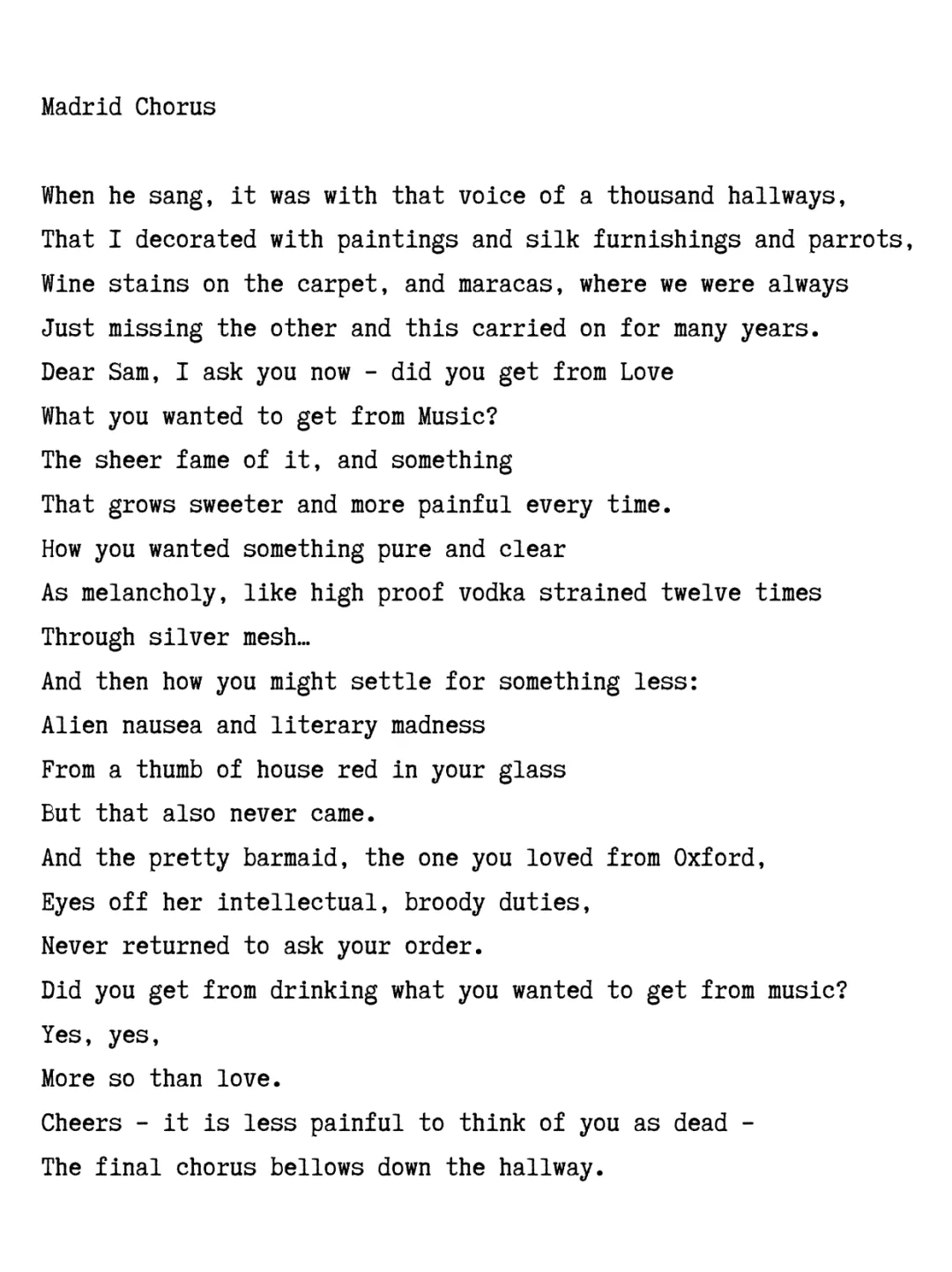
The above is Sarah Fletcher's poem Madrid Chorus, published in The London Magazine. The poem constructs its narrative through a subtle use of bathos: beneath a melancholic, blue-tinged emotional atmosphere, the speaker drinks like Baudelaire, searching for a crevice between beauty and pain in which to take shelter, while the "something pure and clear" they longs for never arrives.
Everyone's life contains those "ouch" moments — when pain lands on us directly and bodily, when memories in our minds remain tangled with complex emotions and are forever in flux. Our language so often fails to capture these instants with any precision; all we can manage is to cry out an "ouch".
This is why Sarah has spent years devoted to working in this space. In her poetry, pain and memory are the two central cores:
"I’ve always been fascinated by experiences that feel difficult to explain in ordinary language. Pain is one of those experiences, and memory is another. Both are deeply personal, but also strangely universal. A lot of my academic research looks at how language struggles to describe chronic pain, so poetry became a natural space to explore that tension between experience and expression."
These topics transcend era, aligning closely with the concerns at the heart of Confessional poetry, and Sarah's writing naturally inherits that literary tradition while incorporating the new forms and sensibilities of contemporary poetics.
The term "Confessional" originated with the critic M. L. Rosenthal, who coined it in a 1959 review of Robert Lowell's collection Life Studies — though Rosenthal himself later admitted the word had caused no small amount of trouble. It implies a kind of disclosure, a kind of admission of guilt, yet in doing so it obscures what is truly complex about this mode of writing: the "I" in the poem; is it the author herself, or a carefully constructed voice, a persona?
Consider this famous work by Sylvia Plath, one of the defining voices of Confessional poetry:
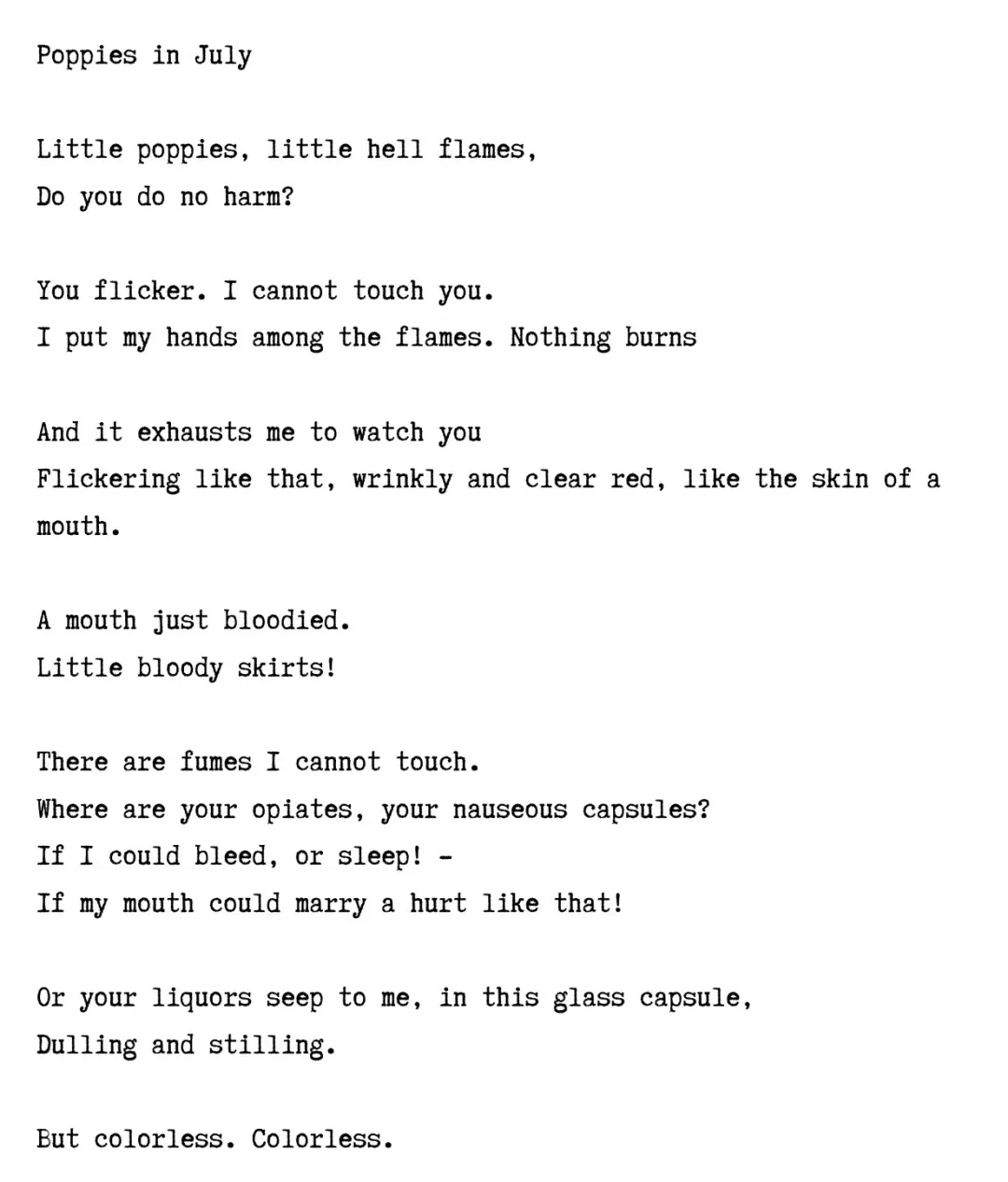
In these brief dozen or so lines, she asked the poppies for two contradictory things: blood ("If I could bleed") and opiates ("where are your opiates"). The blood represents her longing to feel alive, her hunger for sensation; the opiates signals total numbness, the desire to be dulled and stilled. Faced with an unbearable life, she wants both to feel the pain and to feel nothing at all. That moment of vulnerability is fierce and visible.
Poetry allows us to approach these experiences and instants indirectly, through image, metaphor, and rhythm. Rather than explaining pain or memory in plain terms, it invites us to explore their texture and their quiet contradictions. At the same time, it offers freedom no other form can quite match. You can move swiftly between ideas, images, and emotions without having to account for every step along the way. As Sarah herself puts it:
"Poetry appealed to me because it is such a condensed form of thinking. In a poem, every word matters, and even small shifts in sound or image can change the entire meaning. I like that intensity. It feels closer to the way memory or emotion actually works (in fragments, flashes, and associations."
"Confessional Poetry" may not be a new term, but in this workshop Sarah will draw on her doctoral research to look at poets like Sylvia Plath, Anne Sexton, Emily Dickinson, and Don Paterson — using their work as touchstones to explore how this writing tradition has redrawn the line between private experience and public language, and what today's writers can take from it for their own practice.
Participants will have the chance to turn that lens on their own writing: How honest can we really be on the page? When someone writes a poem about their breakdown, their desires, their rage toward a parent, their time in a psychiatric ward... how does that become literature?
If you want to learn to write poetry, or if the theme of pain and memory speaks to you, this workshop is built for you. You'll learn to sit with pain, memory, emotion, and detail, and find the poetic language that can actually hold those experiences. Along the way, you'll explore questions like:
What makes a poem a poem?
How do different choices about line breaks shape what a poem means?
How do you draw on real life, including the memories that still sting, as material for writing?.
Learning to write poetry isn't just about picking up a new form; it's about absorbing a way of paying attention that will feed everything else you write.
For writers who want to try writing in English or who want to sharpen their English poetry, this course will be just as valuable. The way contemporary English poetry handles density, word choice, and rhythm will be explored here:
How can a small shift in wording change everything? How do you make every word work at once — in meaning, sound, and rhythm? What's current in contemporary English poetry, and what's become a cliché?... Sarah will bring her academic background to bear and offer guidance from the perspective of a native English speaker, in a structured and practical way.
Workshop Outline
Lesson 1: What is Confessional Poetry?
What does it mean to “confess” in writing?
Close reading: Sylvia Plath, Anne Sexton
Key ideas: voice, “I”, emotional honesty
Lesson 2: Saying vs Showing Pain
Direct emotion vs imagery
Brief comparison with Emily Dickinson
Lesson 3: The Body and Metaphor
How poets describe pain indirectly
Introduce simple metaphor techniques; look at Don Paterson's poem
Exercise: Describe pain as something else (weather, object, place)
Lesson 4: Writing and Editing a Confessional Poem
Combine voice + imagery
Guided writing of a longer poemBasic editing and group feedback.
This Workshop would be on Zoom.
Time: GMT 12:30pm - 2:30 pm
Apr 17 - May 8 (Every Friday)
Meet Sara Fletcher
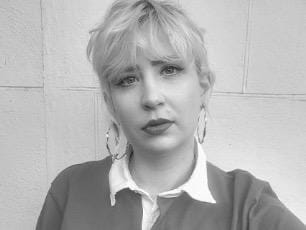
Sarah Fletcher
Sarah Fletcher is an American-British writer currently completing a PhD at Aberystwyth University. Her debut collection PLUS ULTRA came out in 2023 with CHEERIO Publishing.She has over ten years of teaching experience, having taught at Aberystwyth University, University of Bath, The Poetry School, The Writing Squad, The Steiner House, and more.Her poetry has been published in The Poetry Review, The White Review, and Poetry London; her articles and essays have appeared in The Washington Post, The New Statesman, and the Spectator.
Sign Up now! (By April 16th, 2026)


Should you have any question, please email us: Keepintouchsmz@gmail.com